Retinol is the gold standard for anti-aging, but for many, the first few weeks feel like a dermatological disaster (Read more about retinol). Redness, peeling, and stinging—often called “Retinoid Dermatitis”—can be discouraging.
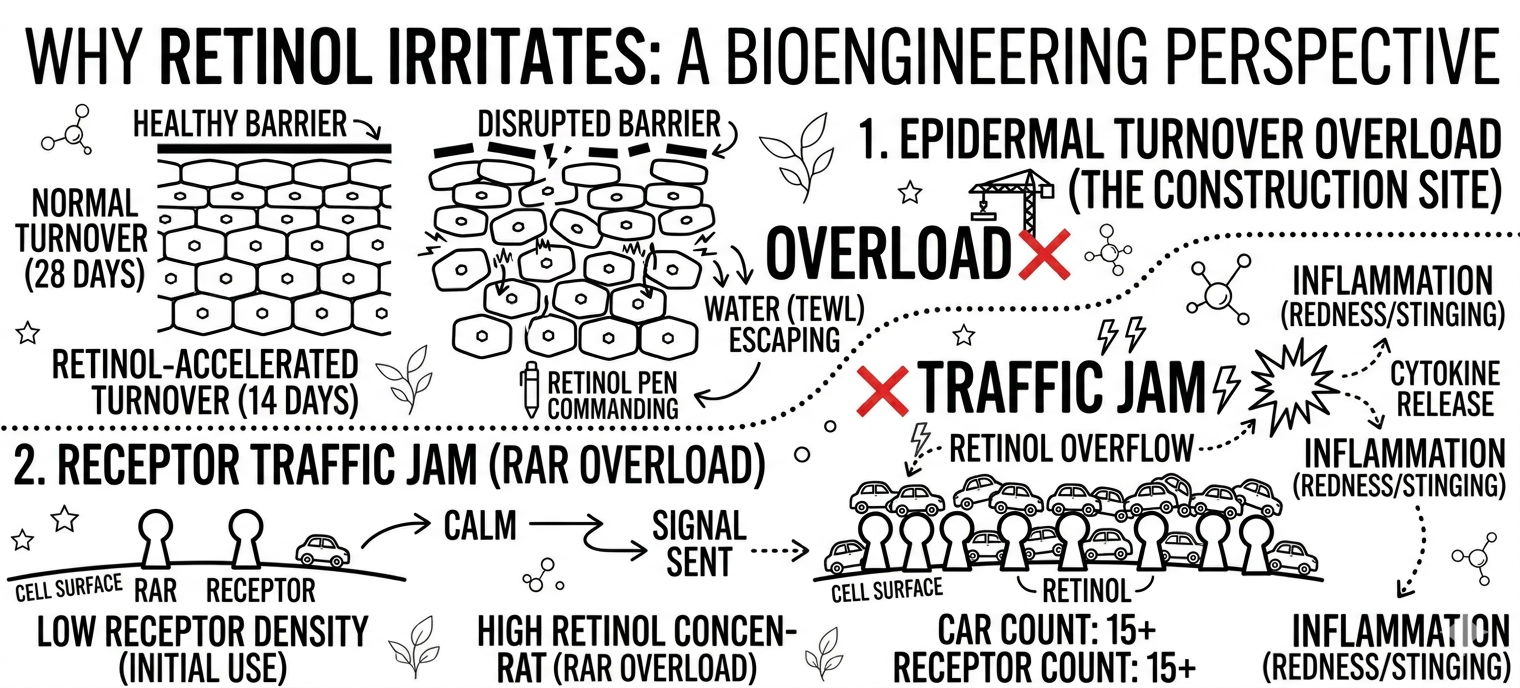
1. The “Construction Site” Overload (Epidermal Turnover)
Think of your skin as a high-rise building. Normally, it takes about 28 days to replace old bricks (dead cells) with new ones.
- The Science: Retinol sends a high-speed command to your basal cells to divide and push upward.
- The Chaos: Imagine a foreman ordering a 28-day job to be finished in 14 days. The new cells push up so fast that the “intercellular glue” (lipids) doesn’t have time to set. The result? Your protective barrier develops gaps, moisture escapes (TEWL increases), and your skin becomes a “construction site” under stress. This is the root cause of peeling and dryness.
2. Receptor Traffic Jam (RAR Overload)
For Retinol to work, it must bind to specific “docking stations” in your cells called Retinoic Acid Receptors (RAR).
- The Science: If you haven’t used Retinol before, your skin has a low density of these receptors.
- The Chaos: When you suddenly apply a high concentration of Retinol, it’s like thousands of cars trying to enter a tiny parking lot. This “traffic jam” triggers an inflammatory response, releasing cytokines that cause the redness and stinging sensation you feel. Your skin isn’t “allergic”; it’s simply overwhelmed by too much information at once.
3. The Solution: An Engineering Approach to Adaptation
In bioengineering, we don’t force a system; we optimize it. To minimize side effects, you need to manage the “flow” of Retinol:
- The “Sandwich” Buffer: Applying a moisturizer before and after Retinol acts as a polymeric barrier, slowing down the diffusion rate of the Retinol molecules. This prevents the “Receptor Traffic Jam.”
- The “Low-Frequency” Ramp: Start with 2 nights a week. This gives your skin time to upregulate (build more) receptors, preparing the “parking lot” for more traffic.
The Bottom Line
Retinol irritation is a sign that your cellular machinery is being reprogrammed. By understanding the molecular logistics of your skin, you can navigate the “retinization” period with science on your side.
Leave a Reply