We’ve all stood in front of the skincare aisle, torn between a $15 drugstore staple and a $200 luxury jar with a French name. The marketing promises a miracle, but as a Bioengineering Ph.D., I look at the back of the bottle—the Inclusion List (INCI) and the Molecular Delivery System.
Is that 10x price jump justified by 10x the results? Let’s break down the engineering of luxury vs. mass-market skincare.
1. The Raw Material Engineering: Purity & Source
Not all “Hyaluronic Acid” is created equal.
- Mass Market: Often uses standard, high-molecular-weight ingredients that sit on the surface. They buy raw materials in massive bulk, which lowers the cost but sometimes results in a broader range of molecular weight distribution.
- Luxury/Medical Grade: High-end brands often invest in Ultra-Pure or Specific Molecular Weight fractions. For example, a luxury cream might use a precise blend of 5 different hyaluronic acid weights to target 5 different layers of the epidermis. You aren’t just paying for the name; you’re paying for the Narrow Polydispersity Index (PDI) of the active molecules.
2. Formulation Engineering: The “Secret Sauce”
Think of skincare like a high-performance engine. You can have the best fuel (actives), but if the engine (the base formula) is poorly designed, it won’t move.
- The Texture & Stability: Luxury brands spend millions on Sensory Engineering. They use sophisticated emulsifiers that create a “weightless” feel while keeping unstable actives (like Vitamin C) from oxidizing.
- The Proprietary Ferments: Brands like La Mer or SK-II use proprietary “Broths” or “Pitera.” From a bio-tech perspective, these are complex Postbiotic Lysates. While a $20 cream can mimic the basic moisture, it often lacks these specific, trade-secret bio-signals that modulate skin inflammation.
3. Delivery Systems: The “Pathway” Premium
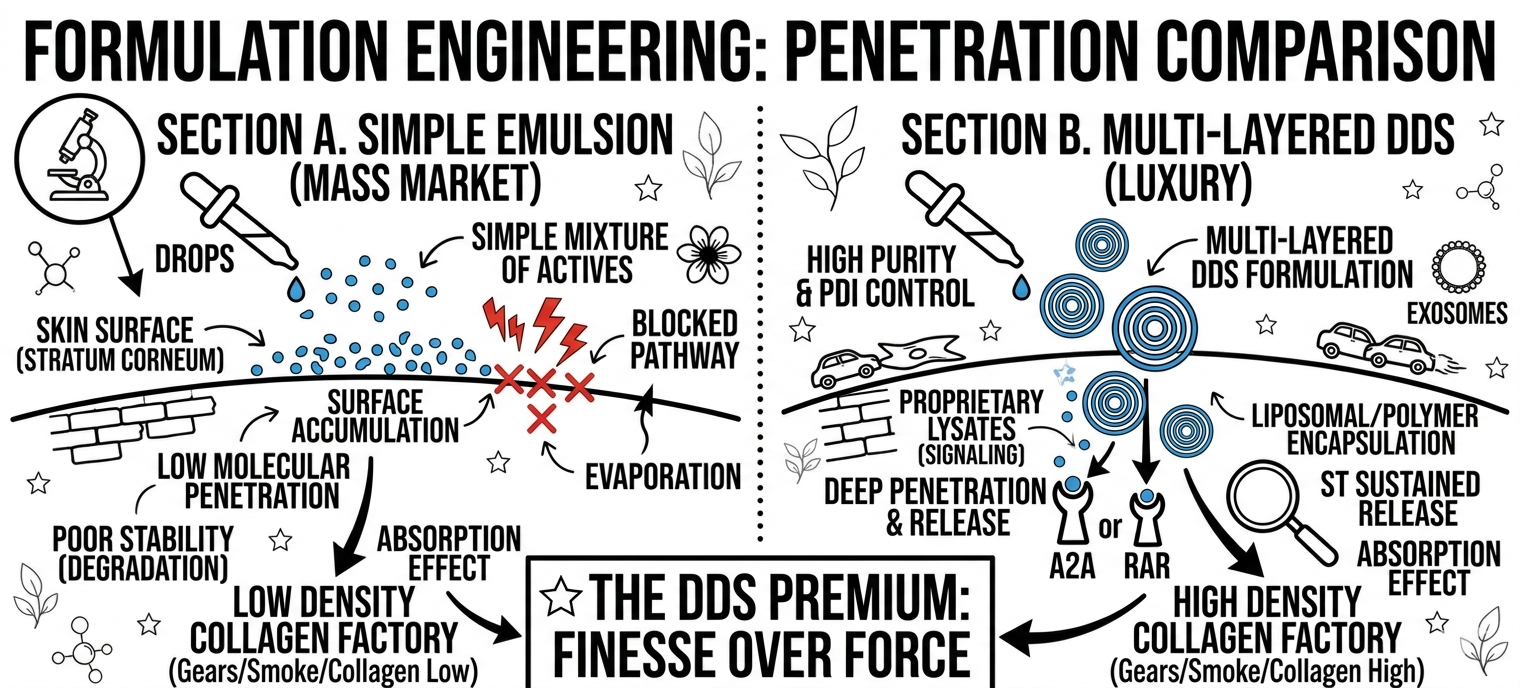
This is where the real price gap lies. A $200 cream often invests heavily in Drug Delivery Systems (DDS).
- The Barrier Challenge: Your skin is designed to keep things out.
- The Luxury Edge: High-end formulas often utilize Liposomal Encapsulation or Polymer Matrix Technology (which I’ve analyzed in my [Liposome post]). This ensures that the expensive peptides actually reach the dermis instead of evaporating or being wiped off on your pillowcase. A cheap cream might have the same peptide on the label, but without the “Delivery Vehicle,” only 1% might actually penetrate.
The Ph.D. Verdict: Where should you spend?
Is it 10x better? Scientifically, rarely. But is it 2x or 3x more effective? Often, yes.
- Save your money on: Cleansers and Basic Moisturizers. A $15 CeraVe or Cetaphil is engineered perfectly for barrier protection. There is no biological need to spend $80 on soap.
- Invest your money in: Targeted Serums (Vitamin C, Retinol, Peptides). This is where the Formulation Stability and Delivery Engineering make a measurable difference in your skin’s molecular architecture.
Leave a Reply